Six bottles, wrapped in brown paper bags, lined up on a kitchen counter. No labels. No clues. Just a row of mystery beers and a group of friends who suddenly realise they have no idea what they're about to drink.
That's the setup. What follows is one of the cheapest, most argumentative and most surprising evenings you can host at home. A blind beer tasting costs you roughly the price of two rounds at a bar per person, and it produces a kind of conversation you don't get from a normal party. People defend their guesses. They get them wildly wrong. A friend who swears by hoppy IPAs discovers he just ranked a pale lager first.
I've organised these evenings for groups of four and for groups of eleven, with craft nerds and with people who think "lager" is a brand. Some worked beautifully. One failed badly enough that I had to change the whole format mid-evening. Here's the full method, including the parts nobody tells you.
Key Takeaways
- Wrap every bottle in opaque paper so no one can see the label — this single step produces 90% of the fun.
- Serve 4 to 6 beers per person, in small 5 cl samples, ordered from lightest to strongest.
- Print a simple score card: appearance, aroma, taste, overall — and a guess column.
- Budget around €8–15 per guest if you buy shared 33 cl bottles instead of individual ones.
- Clean your palate between samples with water and plain bread, not crackers with salt or strong cheese.
- The reveal is the whole point. Do it one beer at a time, never all at once.
How to set up a blind beer tasting party at home
The first thing to understand: blind tasting is not about expertise. It's about removing information so that your senses have to do the work. Strip the label away and people stop performing taste and start actually tasting.
The brown bag method (and why it beats fancy kits)
You don't need a kit. A plain brown paper bag, a rubber band and a marker will do everything a €60 tasting box does. Here's how I run it:
- Buy the beers ahead of time and chill them all to the same temperature — around 8–10 °C for most styles.
- Write a letter on the bag, not the beer name. A, B, C, D.
- Keep the master key on your phone. Not on paper on the table. Someone will find it.
- Pour each sample out of sight of the guests, or pour all samples before anyone sits down.
The catch? You, the host, are now running a small restaurant service while everyone else has fun. If that bothers you, hand the pouring job to one guest who agrees to be "in on it" — they taste last and guess last.
What to put on the table
Keep it boring and functional. Small tasting glasses (5 cl is plenty — a wine glass works fine), a jug of water, plain bread, a bowl for discarded samples, and one score card per person. Avoid cheese boards, salted nuts and citrus-heavy snacks during the tasting itself; they destroy your palate within three samples, and the middle beers get unfairly rated.
I learned this the hard way. My second tasting included a cheese plate. By the fourth beer, nobody could tell a stout from a dunkel, and the scores were meaningless. Save the food for after the reveal.
How to choose the beers (the part that makes or breaks the evening)
Two structures work. Pick one before you shop.
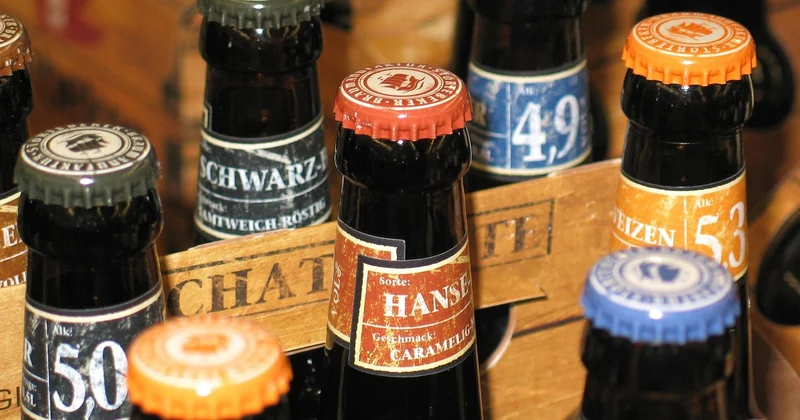
- Single-style flight. Five IPAs, or five stouts. This is harder and more revealing — differences inside one style are subtle, and people get humble fast.
- Wide spread. One lager, one wheat, one pale ale, one IPA, one dark. Easier, more varied, better for mixed groups.
For a first evening, go wide. For a group that already drinks craft beer together, go single-style and watch the arguments start.
Order of service matters more than you think
Always serve light to heavy, mild to strong. A 9% imperial stout served before a pilsner will flatten the pilsner completely — and if the pilsner comes last in blind order, everyone will call it "watery" and score it badly. Then they taste it again after the reveal and feel cheated.
Rough sequence I use: pilsner or lager → wheat or witbier → pale ale → IPA → dark or strong. If you're doing five IPAs, order them by bitterness instead.
How much to buy, and what it costs
Plan 5 cl per sample, so a 33 cl bottle serves four to six people comfortably. For eight guests and five beers, you need five shared bottles — that's often under €25 total. I've run a full evening for ten people on €70 of beer, and a fancier one with imported Belgians for about €140.
| Format | Beers per guest | Sample size | Rough cost per guest | Best for |
|---|---|---|---|---|
| Casual, wide spread | 4 | 5 cl | €6–10 | Mixed groups, first timers |
| Standard blind flight | 6 | 5 cl | €10–15 | Friends who like beer |
| Single-style deep dive | 5 (same style) | 5 cl | €15–25 | Enthusiasts, repeat hosts |
How to do a blind taste test at home (the actual procedure)
Here's the sequence that has worked every time, whether the guests were four sommeliers-in-training or four people who mainly drink coffee.
The 40-minute protocol
- Explain the rules in two sentences. Taste, score, guess. No talking about the beer until everyone has written their score.
- Silent first sip. Everyone tastes sample A without speaking. This is the single rule that changes the evening — silence for the first 30 seconds of each beer.
- Score, then discuss. Appearance, aroma, taste, overall, out of 10 each. Then, out loud, guesses.
- Reveal one at a time. Do not reveal everything at the end. The reveal of each beer resets the conversation and keeps energy up.
That "silent first sip" rule sounds fussy. It isn't. Without it, the loudest guest anchors everyone else's opinion within ten seconds, and you lose half the surprise.
What goes on the score card
Keep it to five lines. Anything more and people stop filling it in honestly.
- Appearance — colour, clarity, head
- Aroma — two or three words, no pressure to be poetic
- Taste — sweet, bitter, sour, roasted? One word each
- Overall — a mark out of 10
- Guess — style, then brand if they're brave
You can draw this on a piece of A4 by hand and print ten copies in five minutes. If you want a template, a simple spreadsheet with one row per guest and one column per beer is enough — and it makes tallying the final ranking trivial.
What is the 3:30-300 rule for beer?
You may have seen this rule circulating in beer communities. It's a mnemonic for three serving temperatures: 3 °C for mass-market lagers served ice cold, 30 °C as a rough upper limit for the temperature at which beer stops being pleasant to drink, and 300 referring to the volume in millilitres of a typical serving.
Treat it as a memory aid, not a brewing standard. The temperature part is the useful bit: cold mutes aroma and bitterness, which is why cheap lagers are served near freezing and why a good stout loses most of its character straight out of the fridge. For a blind tasting, pull everything out 15 minutes before pouring and let it warm slightly. If a beer tastes flat and dull, check the temperature before you blame the beer.
A practical temperature cheat sheet
Lagers and pilsners: 6–8 °C. Wheat beers: 8–10 °C. Pale ales and IPAs: 10–12 °C. Stouts and Belgian ales: 12–14 °C. You don't need a thermometer — 15 to 20 minutes out of the fridge gets you in the right zone for most of them.
The five mistakes I made so you don't have to
I'll be honest: my first attempt was a mess. The mistakes were specific enough that I can list them.
- I revealed everything at the end. By then, everyone was tired and the momentum was gone. Reveal one beer at a time instead.
- I served six beers in one sitting with no break. Palate fatigue is real; by beer five, people were guessing randomly. Six is the ceiling — four is the sweet spot.
- I let one guest write notes out loud. It anchored the whole room. The silent first sip rule exists because of that evening.
- I used a cheese board mid-tasting. Never again.
- I forgot water. You need a glass of still water next to every taster, and bread to reset. Without them, the second half of the flight blurs.
None of these are complicated. They're just easy to overlook when you're excited about the beer list.
DIY beer tasting party ideas that go beyond the basic flight
Once you've run a standard flight, you can add a twist. These are the variations that have landed best with my own groups.
The guess-the-price game
Buy three cheap supermarket beers and two expensive craft ones in the same style. Ask everyone to rank them by price. The results are brutal — the gap between €1.20 and €6 is far smaller than anyone expects. I've seen a group of eight rank a €2.50 lager above a €7 imported one, unanimously.
The winner picks the next beer
Whoever scores highest across the flight chooses the beer for the next tasting. It turns a one-off evening into a small tradition. Ours runs roughly every three months now, and the format has shifted entirely toward whatever the last winner picked.
What if my guests guess everything correctly?
Then your flight is too easy — usually because the styles are too far apart. Move to a single-style tasting, or pick beers within a narrow sub-style. If they still guess everything, congrats: you're hosting experts, and you should be charging admission.
How do I stop palate fatigue from ruining the second half?
Keep samples small (5 cl), serve water and plain bread between beers, and cap the flight at six. If you want to host more than six, split the evening into two rounds with a 20-minute break in between — and serve food with the break, not during the tasting.
Where can I find a good beer tasting near me?
If you don't want to host, look for breweries within driving distance that run open tasting sessions, or a local bottle shop with a tasting room. Most small breweries post events on their own social channels rather than through aggregator listings, so check them directly. But honestly — the at-home version costs less, lasts longer and lets you control the beer list.
Why blind tasting is worth the effort
The part I didn't expect, after running a dozen of these evenings, is what it does to people's taste. Labels are information, and information shapes what you think you're experiencing. Take the label away and you find out which beers you actually like, not which ones you think you should like.
A friend of mine spent years refusing dark beers. She ranked a stout third out of six in her first blind flight, then asked, slightly irritated, why nobody had told her. Nobody had told her because she'd never asked without knowing the answer first.
That's the whole thing, really. Six brown bags on a counter, and a room full of people finding out they were wrong about something they were sure of. Next time you have four friends and an evening to spare, buy five bottles, hide them, and say nothing. The silence at the first sip is the best part.