Thirty seconds. That's roughly how long most people spend on a beer before deciding whether they like it. Three sips, a nod, and back to the fridge. The vocabulary problem doesn't show up until you're sitting across from someone who asks, "What do you actually taste?" and you hear yourself say, "Uh… beer?"
I know that silence well. My first tasting notebook, from a period I'd rather not date precisely, has entries like "good" and "tastes like beer, but better." Then I started building a tasting vocabulary the same way I'd build any other working language: a handful of words at a time, used on real beer, in real glasses, with mistakes logged rather than hidden. That's what this guide is about—how to build a beer tasting vocabulary from scratch, in a deliberate order, with exercises that actually stick.
Key Takeaways
- Start with four anchor descriptors (malt, hops, yeast, body) before touching style jargon.
- Ten new words a week is the ceiling. Twenty is a party trick you'll forget by Friday.
- Write your notes before you read the label. Every time.
- Comparison tastings teach twice as fast as solo drinking—two beers, one variable.
- Answering "what does it taste like?" out loud is the real test, not filling out a grid.
Why your beer tasting vocabulary collapses without a foundation
Most tasting glossaries throw eighty terms at you in one page: biscuity, phenolic, diacetyl, estery. It reads like a wine exam. You close the tab and remember nothing.
The fix is structure. Beer flavour splits into four channels before it splits into a hundred adjectives, and if you learn those four channels first, every new word has somewhere to hang. Without them, terms float in the void.
The four anchors: malt, hops, yeast, body
- Malt — the grain side. Bread, biscuit, caramel, toast, coffee, chocolate.
- Hops — the bitter, aromatic side. Citrus peel, pine resin, grass, stone fruit, herbal tea.
- Yeast — the fermentation fingerprint. Banana, clove, pear drops, pepper, sometimes a warning sign like butter.
- Body — the physical sensation. Thin or syrupy, fizzy or flat, dry or coating.
Everything else is a sub-category of these four. "Tropical" lives under hops. "Bready" lives under malt. Sounds obvious—and yet when I started writing notes without this frame, I'd produce three sentences and stall.
Taste before you read the label
Here's the discipline that changed everything for me: pour the beer, write three words, then turn the bottle around. Labels suggest words you haven't earned. A brewery writes "hints of grapefruit and pine" and suddenly your tongue finds grapefruit and pine, whether or not they're there. Real talk: that's not tasting, that's reading.
Force yourself to commit first. Even if you write "sharp and smells like a lemon" and the label says "citra-hopped with tangerine notes," you've done the work. The label then becomes a check on your perception, not a script for it.
How to learn beer descriptors without drowning in jargon
Progress beats volume. Here's the sequence I'd hand to anyone starting with zero vocabulary, one week at a time.
A five-week starter curriculum
- Week one: four anchors only. No style names, no technical terms. Just malt, hops, yeast, body, one line per beer.
- Week two: ten descriptors total—five malt words, five hop words. Use each at least twice on different beers.
- Week three: add yeast and mouthfeel terms. Notice how a hefeweizen and a pilsner differ in ways that have nothing to do with hops.
- Week four: introduce defect vocabulary (buttery, wet cardboard, green apple). Find one deliberately, if you can—stale beer in a warm glass is a free lesson.
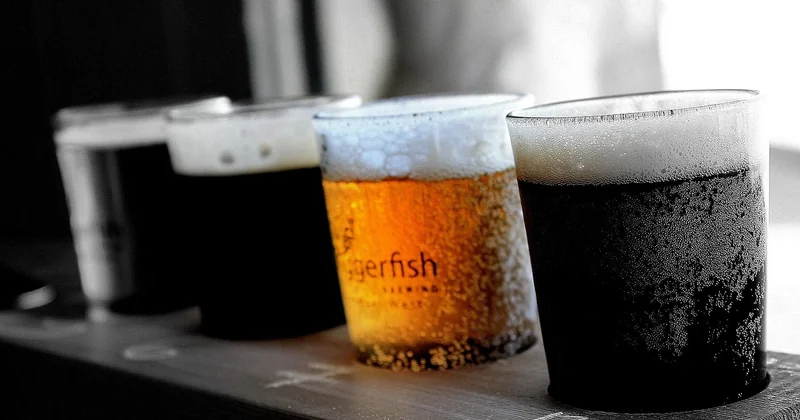
- Week five: compare two beers of the same style from two different breweries and write a paragraph, not a list.
During the first month I kept a running count on the inside cover of my notebook. By week four I had 42 words I could actually use—not just recognise—and I'd thrown out about a dozen that never felt right in the glass. That trimming is normal. A word you can't defend gets dropped.
The three-cube method for practice runs
Here's my own drill, and it's the single most useful thing I've built for myself. Pick three frozen descriptors for each beer: one for smell, one for taste, one for texture. Say them out loud. Then check the label. I called it the three-cube method because you're working with a very small set of options at a time—three boxes to fill, not a thousand.
What it does is force allocation. You can't hedge with "complex." You pick toasty, bitter, thin, and then you defend them. Do this twice a week for a month and the sentences start writing themselves.
The questions you'll hear at the second glass
Once you start talking about beer with any discipline, the same questions surface. Some of them are folklore; some are genuinely useful shorthand. Here's how to handle each.

What is the 3:30-300 rule for beer?
The 3:30-300 rule is a tasting-sequence shorthand used in some beer-education circles: a small pour (around 3 centilitres, roughly 1 oz) tasted for around 30 seconds, with a full evaluation built out over 300 seconds—five minutes—before you move to the next glass. The point is pacing. Quick sip, slow judgement. It's not a universal standard and you won't find it carved on brewery walls, so treat it as a useful habit rather than a law.
What are the three C's of beer?
The three C's commonly refer to colour, carbonation and clarity—the three things you can assess before the beer touches your tongue. Colour tells you roughly what malt bill to expect. Carbonation hints at style and freshness. Clarity reveals whether you're dealing with a filtered pilsner or a hazy ale. Some tasters swap in "character" for clarity; either version works as a pre-taste checklist. I use the visual version because it gives me three words in ten seconds.
What is the 47 rule in beer?
You'll sometimes see a "47 rule" mentioned around beer freshness or serving practice—treat it with caution, because it circulates as tavern shorthand rather than a codified standard, and interpretations vary by region. The honest answer: it isn't a formal brewing or judging rule I'd stake a tasting note on. If someone cites it at the bar, ask what they mean by it and use the conversation as practice. Storytelling is part of beer culture, but a tasting vocabulary should stay anchored to what's in the glass.
What are some common terms used in beer terminology?
A working starter set, grouped so you can learn them in clusters rather than a wall of text:
- Ale vs lager — top-fermenting warm-fermented yeast versus bottom-fermenting cold-fermented yeast. The single most useful distinction to learn first.
- IBU — International Bitterness Units, a measure of hop bitterness. Useful range to know: a light lager sits near 10-15, an IPA often 40-70.
- ABV — alcohol by volume, the percentage on the label.
- SRM — a colour scale, from pale straw to opaque black.
- Mouthfeel — the texture on the palate; carbonation, viscosity, astringency.
- Dry-hopping — adding hops after fermentation for aroma rather than bitterness.
- Ester — aromatic compound produced by yeast; banana and pear notes come from here.
Seven terms, and you can hold a coherent conversation about almost any beer on a shelf.
Build a tasting notebook that actually teaches you something
Most tasting sheets are grids. Grids are for storing, not for learning. What worked for me was messier: a small ruled notebook, four lines per beer, no columns.
| Line | What goes there | Example |
|---|---|---|
| 1 | Three smell words, written first | toast, orange peel, faint clove |
| 2 | Three taste words | bitter, bready, slightly sweet finish |
| 3 | Texture, one phrase | thin but prickly carbonation |
| 4 | One sentence: would you buy it again, and why | No — too bitter for me at this strength |
That last line is the one people skip, and it's the one that trains judgement. Preference and perception are different muscles. Writing "I don't like it, and here's the descriptor that explains why" keeps the two from blurring.
Comparison drills: two glasses, one variable
Change one thing and taste twice. Same style, two breweries. Same brewery, two ages of the same beer. Same beer, two serving temperatures. The perceptual contrast is what burns the word into memory—far more than repetition of the same beer ever will. I ran a two-glass comparison every Friday for a season; by the end I could pick out a stale bottle from a fresh one before the first swallow, and I couldn't do that in month one.
What didn't work for me (so you can skip it)
Flashcards. Genuinely useless. I made 120 of them, reviewed them for two weeks, and retained almost nothing because the words weren't attached to a smell. Also: buying expensive beers to practise on. Waste of money. A cheap pilsner and a cheap stout teach malt-versus-hop contrast perfectly well, and you can afford four of them instead of one.
One more honest failure. I spent an embarrassing stretch describing everything as "hoppy" because I didn't yet have hop sub-vocabulary. Everyone does this. The cure is comparing two hop-forward beers side by side and forcing a distinction—one is citrusy, the other is grassy or resinous. Put them next to each other and the words appear.
Where the vocabulary stops mattering
At some point the words stop being the goal. You'll be handed a glass, and before you've named anything, your palate will have already told you something true: this is fresh, this is flat, this is too sweet for what they claimed. The vocabulary sits behind that instinct, ready when someone asks.
So here's what I'd leave you with. Don't chase a glossary. Chase one better sentence per beer than the last one. Ten words a week, written before the label, read aloud to nobody in particular. Six months from now, someone will ask what you're tasting and you'll answer without hesitating—and then you'll notice that the answer came faster than the pause used to.