Two beers, one glass each. Put them side by side on a wooden table, and most drinkers will tell you they can spot the difference in a heartbeat. Then you ask them to actually name it — beyond "one's a bit more yellow" — and things get quiet fast.
That silence is the whole reason I keep running this comparison. A pilsner versus pale ale face-off looks simple on paper: one is a lager, the other's an ale. But push past that label and the two styles split along nearly every line you can measure — yeast, fermentation temperature, malt kilning, hop choice, conditioning time. Get those lines straight and it changes how you buy, brew, and pair both beers.
I'll show you the side-by-side, but I'll also tell you where I've been wrong about it.
Key takeaways
- Fermentation defines the family: pilsner is a bottom-fermenting lager, pale ale is a top-fermenting ale — everything else follows from that split.
- Malt kilning drives flavour: pilsner malt is dried gently and stays pale and grainy; pale ale malt gets a hotter kiln and turns biscuity and toasted.
- Numbers differ more than people expect: typical pilsners run 4.4–5.0% ABV and 30–40 IBU; American pale ales often land at 5.0–5.5% ABV and 30–50 IBU.
- Hops change character, not just bitterness: Saaz and other noble hops give a spicy, herbal edge; American and English hops push citrus, pine, or stone fruit.
- Occasion matters: pilsner wins on refreshment and food versatility, pale ale wins on complexity and aroma.
Pilsner vs pale ale: the numbers, side by side
Here's the table I wish someone had handed me the first time I tried to explain this at a tasting. Ranges are typical commercial examples, not absolutes — brewers love to wander.
| Attribute | Pilsner | Pale ale |
|---|---|---|
| Yeast | Bottom-fermenting (lager) | Top-fermenting (ale) |
| Fermentation temperature | Roughly 8–12 °C | Roughly 18–22 °C |
| Conditioning | Cold lagering, several weeks | Short warm conditioning, days to a couple of weeks |
| Colour (SRM) | 2–5, pale straw to light gold | 5–14, gold to amber |
| Bitterness (IBU) | 30–40 | 30–50 |
| ABV | 4.4–5.0% | 4.5–5.5%, higher for stronger versions |
| Dominant hop character | Spicy, herbal, floral (noble hops) | Citrus, pine, stone fruit (US/UK hops) |
| Malt profile | Clean grain, cracker, bread crust | Biscuit, toast, light caramel |
Read that table twice and a pattern jumps out: the bitterness overlap is enormous. A pilsner and a pale ale can sit at the exact same IBU figure and taste completely different. That's the part that trips up newcomers, and honestly it tripped me up too. Bitterness units measure a chemical concentration, not what your tongue does with it.
Why the hop character matters more than the number
Pilsners lean on noble hops — Saaz from Czechia being the classic — which give a restrained, peppery, herbal lift. The aroma is precise rather than loud. Pale ales, especially American ones, throw in generous late and dry hops for a citrus-and-resin wall of smell that arrives before you taste anything.
So you get two beers with identical bitterness and wildly different personalities. The IBU number tells you almost nothing about the drinking experience once the aroma hops get involved.
What actually separates the two beers
Strip the labels away and four mechanical differences do most of the work. Yeast choice, fermentation temperature, malt kilning, and cold conditioning. Change any one of those and you've built a different beer.
What are the differences between lager, pilsner, and ale?
This question comes up constantly, and the answer is a nested hierarchy, not three separate things. Ale and lager are the two broad families, split by yeast type and fermentation temperature. A pilsner is a specific style inside the lager family — pale, bottom-fermented, cold-conditioned, originating in the Bohemian town of Pilsen in 1842. So every pilsner is a lager, but most lagers are not pilsners. Similarly, pale ale sits inside the ale family.
In other words: ale vs lager is the genus. Pale ale vs pilsner is the species comparison. Hold onto that and the rest of the beer aisle starts making sense.
What are the key differences between Pilsner malt and Pale Malt?
The malt question is where brewing gets wonderfully nerdy. Both malts start as barley, but the kilning schedule separates them. Pilsner malt is kilned gently at lower temperatures, which keeps the colour very pale and preserves a clean, grainy, slightly honeyed sweetness. Pale ale malt gets a warmer, longer kiln run, developing biscuit and toast notes and a deeper gold colour.
Pilsner malt is also noticeably lower in colour and slightly lower in enzymatic power than a standard two-row pale malt, though both are well-modified base malts built to convert starch. Brewers often reach for pilsner malt when they want the malt to stay quiet and let the hops speak; pale ale malt when they want the grain character to carry some weight.
Where my own side-by-side test went wrong
Early on, I set up a blind tasting with two beers I was sure were the perfect contrast: a Czech-style pilsner and an American pale ale. Same glassware, same temperature, same water. I was confident the panel would split down the middle.
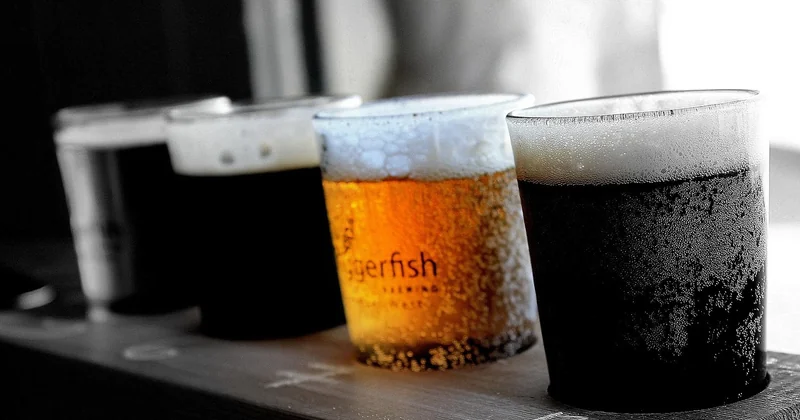
They didn't. Three of the five tasters picked the pale ale as the pilsner. The reason, once we talked it through, was serving temperature: I'd poured both at around 4 °C, and at that cold a citrus-forward pale ale reads as crisp and neutral, closer to a cold lager than the aromatic hop bomb it is at cellar temperature. The pilsner, meanwhile, was already near its ideal and showing its full subtlety.
Lesson learned the hard way: a fair pilsner vs pale ale comparison has to control for temperature, because these beers are designed to be served at different points on the thermometer. Pilsners are happiest around 4–7 °C; pale ales open up closer to 8–12 °C. Judge them at the same cold temperature and you're handicapping the ale.
What are the seven types of beer?
Beer classification is messier than a neat list of seven, since every source draws the boundaries a little differently, but the broad families most brewers recognise are: lagers (including pilsners), pale ales, IPAs, stouts and porters, wheat beers, Belgian-style ales, and sour beers. Some lists swap in amber ales or barleywines for the last slot. The takeaway: pilsner is one node on that map, not a rival category to pale ale.
What is the difference between beer and lager?
Beer is the umbrella term — any fermented beverage made from grain, water, hops, and yeast. Lager is a subset of beer, defined by bottom-fermenting yeast working at cold temperatures followed by a period of cold conditioning (lagering). A pilsner is a lager style. So all pilsners are lager, all lagers are beer, but a pale ale is beer that is not lager, because it's brewed with top-fermenting yeast at warm temperatures.
How to choose between a pilsner and a pale ale
Here's my blunt opinion, and I'll defend it: for most meals and most warm evenings, a well-made pilsner is the better beer. Its carbonation and dry finish cut through fat, spice, and salt in a way that a hoppy pale ale can't without the bitterness clashing. Fried food, sharp cheese, grilled seafood — the pilsner handles all of it.
But pale ale wins when you want the beer to be the event. A thoughtful American pale ale with a few weeks of age on it delivers layers a pilsner never will. Think of it like the difference between a clean citrus sorbet and a fruit tart. Both are excellent. You don't always want the tart.
- Order a pilsner with fried, spicy, or seafood dishes, or when you're drinking several across an evening.
- Order a pale ale when you're having one, slowly, and you want to think about it.
- Skip the pale ale if the glass is served ice-cold; you'll be drinking expensive crisp water.
Pilsner vs pale lager: same thing?
Not quite. Pale lager is a broad category covering any pale, bottom-fermented beer. Pilsner is a specific, hop-forward, gently bitter style within it. A mass-market pale lager is deliberately low on bitterness and hop aroma; a proper pilsner is not. Think of pilsner as the opinionated, hop-driven cousin inside the pale lager family.
What actually stays with you from the tasting
If you take nothing else away: the next time someone tells you a pilsner and a pale ale taste the same, hand them a glass of each and a thermometer. The label "lager vs ale" explains the yeast. It doesn't explain what's in the glass — that comes down to malt kilning, hop choice, and how cold you poured it.
And if you brew either at home? Start with the base malt. Choose pilsner malt when you want the grain to disappear into the background; choose pale ale malt when you want it to stand beside the hops rather than behind them. The rest of the recipe will follow you from there.